
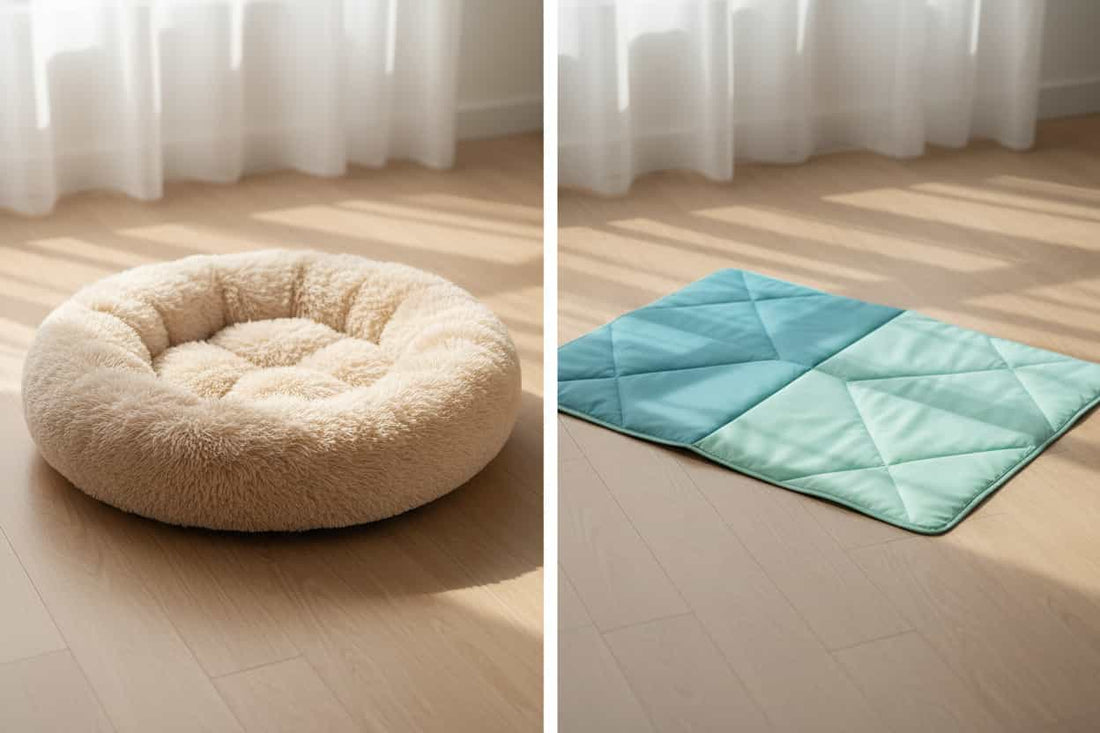
You've decided your dog or cat needs a better place to sleep. You've narrowed it down to two options that keep coming up: a plush memory foam orthopedic bed, or a self-cooling pressure-activated mat. Both promise comfort. Both have strong reviews. Both are completely different products solving different problems.
The right choice depends on one thing: what your pet actually needs from their sleeping surface. This guide breaks down exactly how each works, which pets benefit most, and how to choose without guessing.
Quick Comparison
| Factor | Memory Foam Orthopedic Bed | Self-Cooling Pressure Mat |
|---|---|---|
| Primary benefit | Joint support & pressure relief | Temperature regulation |
| Best for | Senior, arthritic, large breed dogs | Hot sleepers, summer use, post-surgery |
| Surface feel | Plush, cushioned, warm | Firm, cool, smooth |
| Works in all seasons | Yes | Best in warm conditions |
| Washable cover | Yes (removable) | Wipe-clean or rinse |
| Ideal weight range | All sizes — especially large breeds | All sizes |
| Cats suitable | Yes | Yes |
| Elevated off floor | No | No (flat mat) |
| Price range | Higher | Lower–mid |
The Case for Memory Foam
Memory foam distributes your pet's body weight evenly across the sleeping surface — eliminating the pressure points that cause joint pain, stiffness, and disrupted sleep in older or larger animals. Unlike standard polyfill beds that compress and flatten over time, quality memory foam maintains its support structure through thousands of sleep cycles.
This makes it the stronger choice for:
- Senior dogs and cats — aging joints need consistent pressure relief, not a surface that bottoms out after a few weeks
- Large and giant breeds — heavier animals create more pressure on hips, elbows, and shoulders; memory foam is the only material that reliably distributes that load
- Dogs with arthritis, hip dysplasia, or post-surgical recovery — vet-recommended for animals needing orthopedic support
- Pets that sleep heavily on one side — the contouring effect reduces the "pressure point" problem that causes pets to shift and wake repeatedly
Our Orthopedic Dog Bed for Large Dogs — Plush Comfort is built with thick memory foam core and a removable, washable plush cover. Suitable for dogs and cats of all sizes.
The Case for a Cooling Mat
Self-cooling pressure-activated mats work through gel technology that absorbs body heat on contact and dissipates it without electricity or refrigeration. Press down, feel the cool. It recharges automatically after a few minutes without contact.
Cooling mats win when:
- Your pet overheats during sleep — thick-coated breeds, brachycephalic dogs (pugs, bulldogs, French bulldogs), and cats in warm climates all benefit significantly
- It's summer or you don't have air conditioning — a cooling mat can reduce your pet's surface temperature by several degrees without any power
- Post-surgery or injury recovery — cooling reduces inflammation at contact points during rest
- Your pet refuses soft beds — some dogs and cats simply prefer a firm, flat surface; a cooling mat gives them that preference plus a thermal benefit
- You need a portable solution — mats roll up, travel easily, and work in cars, crates, and outdoors
Our Cooling Pet Bed — Self-Cooling Pressure-Activated Mat activates on contact, requires no electricity, and works for dogs and cats of all sizes.
Which Bed Is Right for Your Pet — Decision Guide
- My dog is 7+ years old or has joint issues → Memory foam orthopedic bed
- My pet sleeps hot and pants during rest → Cooling mat
- My dog is a large or giant breed → Memory foam (weight distribution is critical)
- It's summer and my home gets warm → Cooling mat
- My pet is recovering from surgery → Cooling mat for inflammation + memory foam for long-term recovery
- My cat refuses every bed I buy → Try the cooling mat first — cats often prefer firm, cool surfaces
- My pet has arthritis → Memory foam, consistently
- I need something I can take in the car → Cooling mat
Can You Use Both?
Yes — and for many households, both serve different purposes. The memory foam bed is the primary sleep surface for overnight rest and joint recovery. The cooling mat goes in the living room, the car, or outdoors for daytime napping in warm weather. They complement rather than compete.
A Note on Elevated Cots
If your pet runs hot and needs joint support, a third option worth considering is an elevated mesh cot — our Elevated Mesh Pet Cot raises your pet off the floor for airflow underneath while providing a firm, supportive surface. Not as cooling as a gel mat, not as cushioned as memory foam — but a strong middle-ground for pets that need both.
Common Questions About Pet Beds
Is memory foam actually better for dogs with arthritis?
Yes — veterinary physiotherapists consistently recommend memory foam over standard polyfill or flat beds for arthritic dogs. The pressure-distributing properties reduce the localized stress on inflamed joints that causes pain and disrupted sleep. Look for beds with at least 3–4 inches of memory foam depth for large breeds.
Do cooling mats actually work?
Yes — pressure-activated gel mats genuinely reduce surface temperature on contact. The effect is most noticeable in warm environments and for thick-coated or brachycephalic breeds. They're not a substitute for air conditioning in extreme heat, but they make a measurable difference in your pet's comfort during rest.
Are cooling mats safe for pets to chew?
Most cooling mats are made from durable, non-toxic materials, but they're not chew-proof. If your pet is a destructive chewer, supervise initial use. The gel inside modern mats is generally non-toxic if ingested in small amounts, but contact the manufacturer if your pet punctures the mat.
How long does a cooling mat stay cool?
Pressure-activated mats stay cool for as long as your pet is lying on them — the gel continuously absorbs and dissipates heat. After your pet gets up, the mat recharges within 15–20 minutes and is ready for the next use.
What size memory foam bed does my dog need?
Your dog should be able to stretch out fully without hanging over the edge. Measure your dog from nose to tail base when lying down and add 20–30cm. For large breeds, always size up — a bed that's too small defeats the orthopedic purpose.
Can cats use memory foam dog beds?
Yes — cats benefit from memory foam just as dogs do, particularly senior cats with joint stiffness. Cats tend to prefer beds with raised bolster edges for a sense of enclosure, so look for orthopedic beds with bolster sides if your cat likes to curl up against something.
Verdict
Choose memory foam if your pet is older, larger, arthritic, or needs consistent overnight joint support.
Choose a cooling mat if your pet overheats, it's warm weather, or you need a portable secondary sleep surface.
Consider both if you have a senior large-breed dog in a warm climate — they need joint support and temperature regulation.
🛏️ Shop the Orthopedic Memory Foam Bed ❄️ Shop the Self-Cooling Pet Mat