
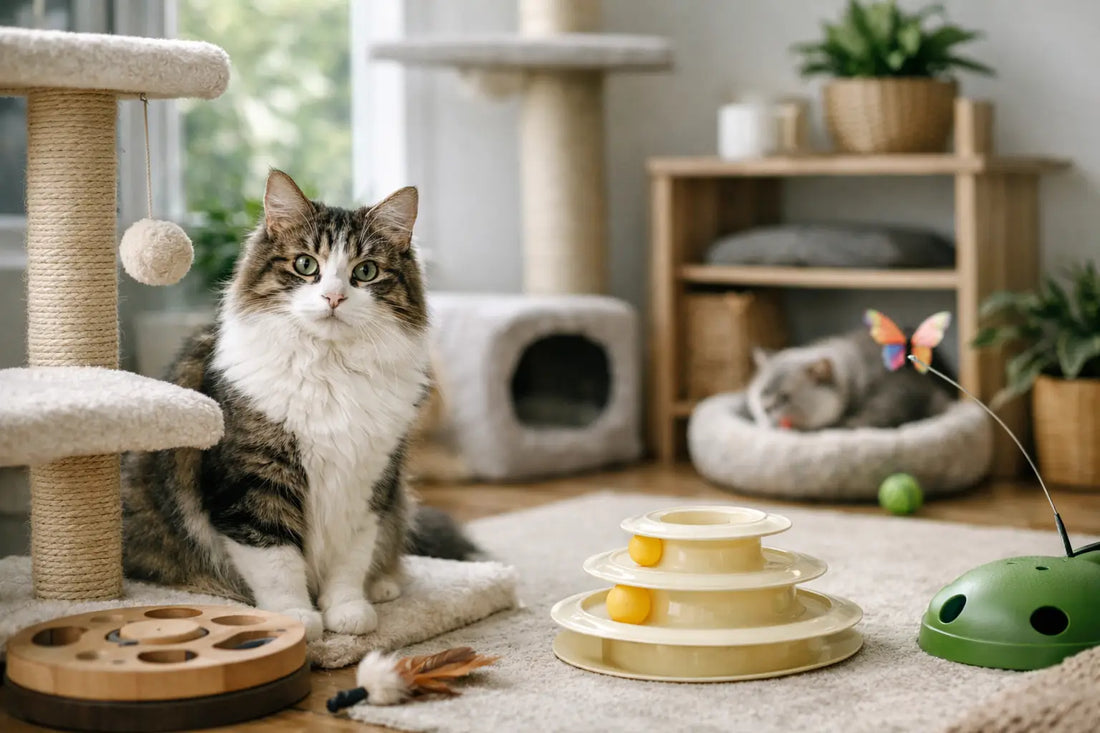
At 2 a.m., the zoomies are not a personality flaw. They are often a clue. If your cat is sprinting down the hallway, pawing at cabinet doors, or treating your sofa like a scratching post, this guide to indoor cat enrichment is here to help you read the behavior for what it is - unmet mental and physical needs.
Indoor cats are safer in many ways, but safety alone does not create a satisfying life. Cats still need to stalk, climb, scratch, hide, patrol, and solve small problems throughout the day. When those instincts have nowhere to go, the result can look like boredom, restlessness, overgrooming, attention-seeking, nighttime chaos, or tension between cats in the same home.
The good news is that enrichment does not have to turn your living room into a pet store aisle. The best setup is usually thoughtful, not excessive. A few well-chosen pieces, rotated with intention, can make an apartment or house feel far more interesting to your cat while still looking clean and cohesive in your space.
What indoor cat enrichment actually means
A good guide to indoor cat enrichment starts with one simple idea: enrichment is not just toys. It is the full environment your cat moves through every day.
That includes vertical territory, scratching options, interactive play, food puzzles, restful hiding spots, window access, and predictable routines. Each one supports a different instinct. Climbing builds confidence. Scratching maintains claws and marks territory. Hunting-style play gives your cat a way to chase and pounce without inventing their own target, which is how ankles and curtains get involved.
It also helps to remember that enrichment should match the cat in front of you. A bold young cat may want speed, novelty, and a challenge. A senior cat may prefer lower climbing surfaces, gentle puzzle feeders, and short bursts of play. A nervous cat often benefits most from secure hiding spaces and quiet observation points before they are ready for more active games.
Start with the layout of your home
Before you buy another wand toy, look up. Many indoor cats need more usable territory, not more floor clutter. Vertical space can change the feel of a home for a cat because it creates options - a place to observe, retreat, and feel in control.
A sturdy cat tree near a window is often one of the highest-impact upgrades. It supports climbing, stretching, resting, and bird-watching in one footprint. In smaller homes, this matters even more. You are not adding one more item. You are creating a whole extra layer of territory.
Placement matters. A cat tree tucked in a dark corner may be ignored, while the same tree near natural light becomes a favorite hangout. If you have more than one cat, spread resources out. One impressive tower is great, but it does not solve social pressure if every cat has to negotiate for the same perch.
Hiding spots deserve equal attention. Not every cat wants to be visible all day. Covered beds, cozy nooks, and quiet corners help cats decompress, especially in busy households. Confident behavior often starts with having a safe place to disappear.
Scratching is a need, not a bad habit
If your cat scratches the couch, the problem is rarely scratching itself. The problem is usually that the better scratching option is missing, unstable, or in the wrong place.
Cats scratch after naps, during moments of excitement, and in areas they want to claim. That is why a scratcher beside the sofa often works better than one hidden in the laundry room. You are not trying to ban the instinct. You are redirecting it to a surface that feels just as satisfying.
Material and orientation both matter. Some cats want a tall vertical post for a full-body stretch. Others prefer horizontal cardboard pads. Many want both. A scratcher should feel solid, tall enough for extension, and easy to access. If it wobbles, your cat may reject it immediately.
For modern homes, this is where design actually helps. When scratching surfaces blend into the room instead of looking disposable, you are more likely to keep them in the places your cat truly needs them. That makes success far more realistic.
Play should feel like hunting
A laser pointer can burn energy, but it often leaves the hunt unfinished. Cats do best when play follows a sequence: stalk, chase, pounce, catch. That means toys your cat can physically grab are usually the most satisfying.
Wand toys are a staple because they mimic movement and let you change speed, height, and direction. Drag the toy behind furniture, pause it like hidden prey, then make it dart away. Short sessions are enough. Ten focused minutes twice a day can do more than a basket full of ignored toys.
Independent play matters too, especially for households where workdays are busy. The trick is rotation. Leave every toy out all the time and most cats stop noticing them. Rotate a smaller mix every few days so novelty stays high without constant buying.
If your cat loses interest quickly, the issue may be style rather than motivation. Some cats love fluttery, bird-like movement. Others want fast, low, mouse-like motion. Watch what makes your cat crouch, chirp, or lock in, then lean into that pattern.
Food enrichment slows the day down
One of the easiest ways to improve indoor life is to make mealtime less predictable. In nature, cats do not walk to a bowl and finish dinner in sixty seconds. They search, stalk, and work for food in small bursts.
Puzzle feeders, treat balls, and simple foraging games help recreate that process. They give your cat something to solve, stretch the eating experience, and reduce boredom that can spill into begging or yowling. For highly food-motivated cats, this can be a game changer.
Start easy. If a feeder is too difficult, your cat may give up or become frustrated. Once they understand the idea, increase the challenge gradually. Some cats enjoy dry-food puzzles most, while others prefer lick mats or treat hunts with small rewards hidden around the room.
This is also one of the cleanest forms of enrichment for a design-conscious home. It creates activity without adding visual noise, and many feeding tools are easy to store between meals.
Sensory enrichment counts too
Not every form of enrichment has to be active. Watching birds from a secure perch, sniffing silvervine or catnip, listening to outdoor sounds through a screened window, or rubbing against different textures all add variety to indoor life.
Window views are especially valuable. A perch near a safe, interesting view can hold a cat’s attention longer than many toys. If the window faces a blank wall, try changing the location. If your cat is overstimulated by outdoor cats, though, a busy window may create stress instead of entertainment. This is one of those cases where it depends on the individual cat.
For some homes, an exercise wheel can be a smart upgrade, particularly for high-energy cats with a strong need to run. But it is not a universal fix. Some cats take to it quickly, others ignore it completely, and some need patient training. It works best as one part of a broader setup, not the entire strategy.
Routine makes enrichment work better
Cats usually thrive on predictability. A home can be full of great enrichment tools and still feel frustrating if access, timing, and interaction are inconsistent.
Try anchoring the day with a few reliable touchpoints: active play before meals, a quiet perch in the morning sun, a puzzle feeder in the afternoon, and a calming wind-down in the evening. Predictable rhythms can reduce demand behaviors because your cat stops feeling like stimulation arrives at random.
This matters even more in multi-cat homes. Competition often shows up around favored windows, feeding stations, and sleeping spots. If you notice blocking, staring, or subtle tension, the answer is usually more distributed resources, not stricter discipline.
How to tell if your indoor cat enrichment is working
You are not aiming for a cat who is busy every minute. You are aiming for a cat who can express natural behaviors in healthy ways, then settle comfortably.
Positive signs include more relaxed rest, less destructive scratching, fewer attention-demanding outbursts, and better sleep patterns at night. You may also notice your cat becoming more confident, more playful, or less fixated on one frustrating behavior.
If nothing changes, simplify and observe. Sometimes a cat ignores a toy because the placement is wrong. Sometimes a scratching post fails because it is too short. Sometimes what looks like boredom is actually pain, anxiety, or a medical issue. If your cat suddenly stops playing, becomes withdrawn, or starts overgrooming, it is worth talking with your veterinarian.
The most successful homes rarely use enrichment as a one-time fix. They build it into daily life in a way that feels natural, attractive, and easy to maintain. That is the sweet spot. Your cat gets more chances to climb, hunt, scratch, and rest, and your home still feels like home - just better designed for the animal who shares it with you.